
The Raft of the Medusa by Théodore Géricault
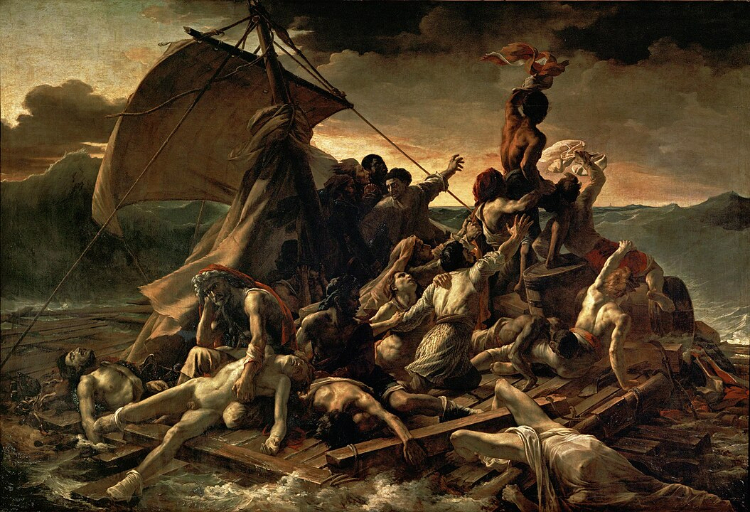
The Raft of the Medusa by Théodore Géricault
If you ever had any fears of sailing the open sea, The Raft of the Medusa will not allay those fears. The painting represents a contemporary event -2 years prior to the painting- in which a politically appointed, inexperienced captain ran the French ship Medusa into an offshore sandbar.
Unable to free the ship from the sandbar, officers and VIPs boarded the minuscule number of lifeboats and left the 150 remaining passengers and crew to build a raft from the scuttled ship.
Showing their compassion, the officers attached a line to tow the raft with them. Deciding compassion was overrated when the raft slowed their progress too much, the officers cut the line shortly thereafter, leaving the raft to drift free.
Around 150 people boarded the raft. 2 weeks - and a keen taste for long pig - later, 15 people were rescued.
Take note, would-be sailors: Maybe it's not the best idea to name your ship after a bloodthirsty snake goddess and expect good results at sea.
Perfectly composed
The Raft of the Medusa is often noted for its composition. Géricault studied the historical details of the disaster exhaustively before settling on a final revision. The painting is framed, primarily, by two large triangles.
The Doom triangle on the left represents the dead and dying left abandoned by their fellow sailors. The Hope triangle is capped by a survivor waving a white cloth toward a ship in the distance (the ship that would ultimately rescue them, but not for several more hours, as it missed them on the first pass, further adding to their despair).
The viewer's eye is drawn primarily to the peaks, from left to right, creating a dynamic from a sense of despondency to a sense of hope. That hope is blunted (much like the survivors' hope was when they were first stranded) by the artist's color palette. He uses muted colors to represent a dark and gloomy sea, when in actuality, the rescue occurred during a sunny day.
In choosing a palette that didn't match the historical account, Géricault adhered to the ideals of Romanticism by preferring emotion over objective reality.
Isn't it romantic?
Géricault's painting is representative of the Romantic period of the early 19th century. Far from our modern definition equating romanticism to love (Mary Shelley's Frankenstein, for instance, is also considered Romantic art), Romanticism often focuses on dynamic movement and the emotional interpretation of the artist.
In contrast, the previous period, neo-Classicism, emphasized historical themes and rational thought associated with the early Enlightenment period. By Géricault's time, the world realized that, while science had assumed a more prominent role in society, emotions and random events often trumped reasoning and logic. Romanticism emphasized, via artistic means, this discrepancy between the ideal and the real.